When you click on links to various merchants on this site and make a purchase, this can result in this site earning a commission. Affiliate programs and affiliations include, but are not limited to, the eBay Partner Network.
Hummer H2For those who like a little more gleam to their Hummer, the H2 offers a similar rugged look as the H1, but as a lower cost, and with more added features, making it almost a massive luxury SUV.
YT ERROR! Don't open the case with a screwdriver!!!! I use XA, & have plenty on hand with multiple blades, for many projects. Btw, the basic knife sets are CHEAP on eBay.
They've been abused quite a bit, not cheap and not the the best either, Ive had many types over the years, seems nobody makes quality ones any more. Xcelite used to be top-notch, not any more, this set was better and blades seem to all produced by the same source.
Regarding the actuator, what I actually need to know is what's inside electrically, it seems there may be some electronics.
I've searched on-line but cannot find any pictures of a dismantled mechanism, BTW if anybody has some it would great to see them.
Checking with a scope and multimeter I found there is absolutely no continuity across the actuator and I mean none, no even mega-ohms. TBH I was expecting to find a motor with a resistance of about 15 Ohms with the polarity being reversed to either Lock or Unlock.
This doesn't appear to be the case, the DDM sends a pulse train out on C2-21, its either communicating, checking loads or something, but it doesn't look to be accidental. Below, Trace 1 is pin C2-21 and the scale 5V/div and 1ms/div
These images were taken with a storage scope with complex triggering capabilities.
There are 21 pulses around 0.2uS wide, sometimes the height of the pulse train is only 7V'ish but very distinct.
The lock cycle has a nice +12V 400ms pulse, as one would expect, bottom trace is the Lock Pin:-
The UnLock Pin (C2-20) is a different story:-
For the last two images the scales are 5V/Div and 0.1s/div, the top trace is the UnLock pin and the bottom trace the Lock pin.
As can be seen there is some activity for unlock, there;s a small bump on the bottom trace and even small bump on the top trace, it almost as if the unlock cycle is done by a return spring.
It could be the pulse train activates a circuit inside, or the actuator has multiple diodes in series (more than my multimeter can switch on) so it only "appears" in circuit at high voltage i.e. > 3V or so.
So as you can see I have absolutely no idea about the internals, hence the request.
The actuator is working 100% OK I'm not trying to fix it, just understand it.
Got caught up on your voltage readings? Look inside there's a motor and a worm gear. AC/DC motors are prone to seize without lubrication. I never replace, just take apart clean & lube.
Thank you hummerz for your picture, it's most helpful.
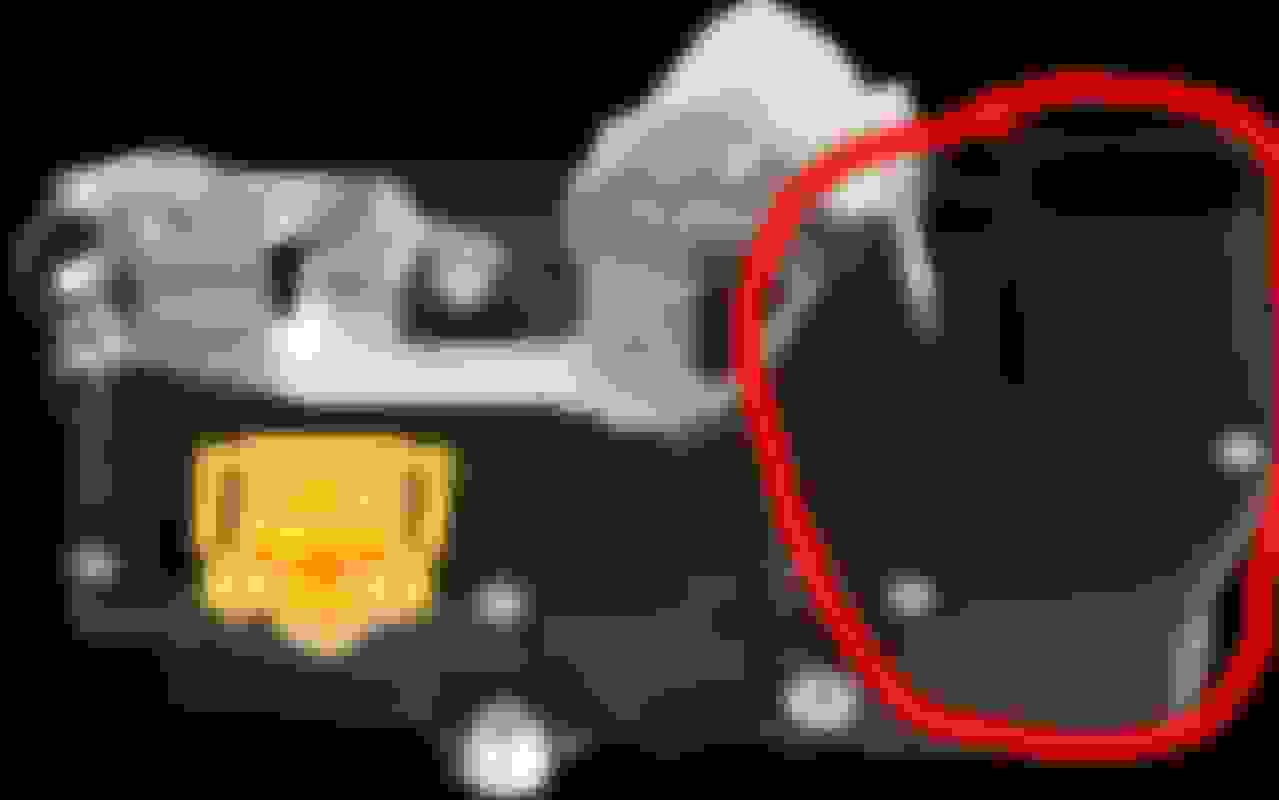
Mechanically it looks as one would expect i.e. geared-down drive and worm-gear to drive the actuator arm.
It would be interesting to know is if the connector-pins link directly to the motor, or are there some electronics in-between, perhaps behind the black connector section (in red)?
In similar fashion, the power-fold mirror drive-motor-assembly has electronics inside that sits between the wires and the motor (electrically speaking) could GM have used a similar method for this?
You may never have accessed that particular section, because, as you say, issues tend to be mechanical.
My measurements could be in error, but they've been checked with a LeCroy storage scope, a Fluke oscilloscope and a Fluke multimeter and all agree with each other.
Also with a fully 100% reversed engineered, 3D modelled DDM, I'm 100% confident the pins are correct (C2 Pins 20+21) plus the cabling matches-up with the wiring diagram.
In the 3D DDM image shows, highlighted in orange, the connection from Pin 21 to the driver chip, Pin 20 is to the right next to it (but software only allows single track highlighting)




 Driver Door Lock Actuator