


Need new brakes any recommendations?????????


Senior Member
Joined: Jul 2012
Posts: 9,042
From: C-Town

"The Effect of Rotor Crossdrilling on Brake Performance"
2006-01-0691
David Antanaitis and Anthony Rifici
General Motors Corporation
http://www.google.com/url?sa=t&rct=j...-Z4wshdrz3Vlrg
They examined cross-drilled rotors vs standard rotors to measure convection cooling capability, fade characteristics, wet braking, pedal feel and lining wear. The result is summarized as follows:
For the sports sedan, the coefficient of friction was 21% higher for drilled rotors than standard front rotors at 340F and higher using 15 brake snubs at 62mph. The track simulated 124 mph fade test showed 37% better brake output for drilled rotors. The drilled rotor brake temperature was about 150 degrees cooler.
For the performance car, the coefficient of friction was significantly higher for drilled rotors especially at high temperature.
Pedal force was much more consistent with drilled rotors over the brake temperature range. That is, to stop at the same deceleration rate, the driver does not need to modulate pedal pressure based on different brake temperatures. This reduces driver fatigue and improves brake response.
They also reported that drilled rotors prevent pad resin glazing on the rotor. There you have solid evidence that drilled rotors have benefits over standard rotors.
2006-01-0691
David Antanaitis and Anthony Rifici
General Motors Corporation
http://www.google.com/url?sa=t&rct=j...-Z4wshdrz3Vlrg
They examined cross-drilled rotors vs standard rotors to measure convection cooling capability, fade characteristics, wet braking, pedal feel and lining wear. The result is summarized as follows:
For the sports sedan, the coefficient of friction was 21% higher for drilled rotors than standard front rotors at 340F and higher using 15 brake snubs at 62mph. The track simulated 124 mph fade test showed 37% better brake output for drilled rotors. The drilled rotor brake temperature was about 150 degrees cooler.
For the performance car, the coefficient of friction was significantly higher for drilled rotors especially at high temperature.
Pedal force was much more consistent with drilled rotors over the brake temperature range. That is, to stop at the same deceleration rate, the driver does not need to modulate pedal pressure based on different brake temperatures. This reduces driver fatigue and improves brake response.
They also reported that drilled rotors prevent pad resin glazing on the rotor. There you have solid evidence that drilled rotors have benefits over standard rotors.


Senior Member
Joined: Jul 2012
Posts: 9,042
From: C-Town
I'm not a brake professional but if I read several articles correctly, ceramic brakes rotors/pads do very little for initial braking capacity. The improvement is seen for extended use such as racing or heavy hauling where the brakes will get exceptionally hot and ceramic has better heat dissipation and less chance of fatigue. Old timers will tell you that asbestos brakes where by far the best.
What "point" were you making that I "proved"?

Senior Member
Joined: Jul 2012
Posts: 9,042
From: C-Town
"Simulating Heating of Brake Discs in a Car"
Brake failure can be caused by many things, one of which is the overheating of the brake’s disc. Let’s study a scenario of a car in panic brake mode, and find out how hot the brake discs and pads get as well as how much they cool down in between brake engagements.
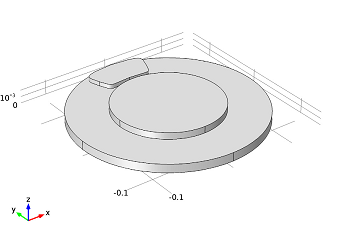
Geometry of a car’s brake disc and pad in 3D.
When Brake Discs Overheat
Let’s suppose a car is traveling at 56 mph, until the driver suddenly panic brakes for 2 seconds. At that point the eight brake pads slow the car down at a rate of 10 m/s2. (We’re assuming the wheels don’t skid against the road). Upon braking for two seconds the driver releases the brake, leaving the car traveling at 5 m/s for eight seconds without engaging the brakes.
When the driver is pressing down on the brakes, kinetic energy is transformed into thermal energy. If the brake discs overheat, the brake pads cease to function through brake fade where the material properties of the brake change due to the temperature overload. This is why it’s so important during the design-stages to simulate the transient heating and convective cooling to figure out what the minimum interval between a series of brake engagements is.
Simulating Transient Heating and Final Temperature of a Brake Disc
If we continue with our scenario as outlined above, we can ask ourselves two questions:
How hot do the brake discs and pads get when the brake is engaged?
How much do the discs and pads cool down during the rest that follows the braking?
By using COMSOL Multiphysics and the Heat Transfer Module, we can model the transient heating and final temperature of the car’s disc brake in the given brake-and-release sequence.
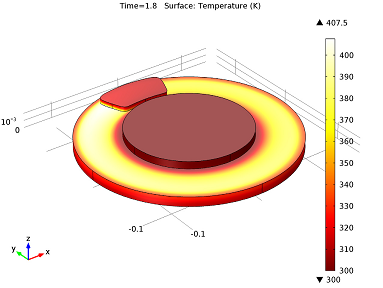
Surface temperatures of the disc and pad immediately prior to releasing the brake at t=1.8 s. Plot showing temperature versus time with a radial line.
As you can see in the figure above, there is a hot spot where the pad and the disc touch (at the brake pad’s edge). This is the area that could overheat to the point of brake failure or fade. Naturally we’d want to examine this further, which is where the right-hand figure comes into play. Plotting the temperature versus time along the line from the center to the edge of the pad is helpful in investigating the hot spot we found. This actually showed a maximum of about 416K occuring after just one second from applying the brakes, and not the two seconds you would intuitively think.
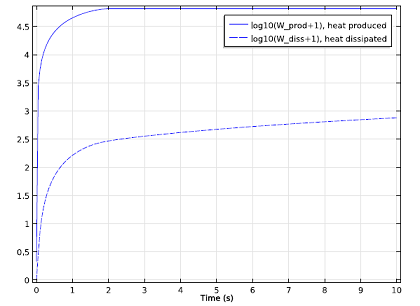
Plot comparing the total produced heat (solid) and dissipated heat (dashed).
Now, in terms of cooling the brake discs and pads (our second question), the plot above will be of assistance. As you can see, the solid line depicts how much heat is produced and the dashed line shows how much heat is dissipated into the air. Eight seconds after the driver has stopped braking, a mere fraction of the produced heat has dissipated. In other words, in order to cool down the system sufficiently the brake needs to remain disengaged for a lot longer period than these eight seconds (100 seconds, in fact).
Brake failure can be caused by many things, one of which is the overheating of the brake’s disc. Let’s study a scenario of a car in panic brake mode, and find out how hot the brake discs and pads get as well as how much they cool down in between brake engagements.
Geometry of a car’s brake disc and pad in 3D.
When Brake Discs Overheat
Let’s suppose a car is traveling at 56 mph, until the driver suddenly panic brakes for 2 seconds. At that point the eight brake pads slow the car down at a rate of 10 m/s2. (We’re assuming the wheels don’t skid against the road). Upon braking for two seconds the driver releases the brake, leaving the car traveling at 5 m/s for eight seconds without engaging the brakes.
When the driver is pressing down on the brakes, kinetic energy is transformed into thermal energy. If the brake discs overheat, the brake pads cease to function through brake fade where the material properties of the brake change due to the temperature overload. This is why it’s so important during the design-stages to simulate the transient heating and convective cooling to figure out what the minimum interval between a series of brake engagements is.
Simulating Transient Heating and Final Temperature of a Brake Disc
If we continue with our scenario as outlined above, we can ask ourselves two questions:
How hot do the brake discs and pads get when the brake is engaged?
How much do the discs and pads cool down during the rest that follows the braking?
By using COMSOL Multiphysics and the Heat Transfer Module, we can model the transient heating and final temperature of the car’s disc brake in the given brake-and-release sequence.
Surface temperatures of the disc and pad immediately prior to releasing the brake at t=1.8 s. Plot showing temperature versus time with a radial line.
As you can see in the figure above, there is a hot spot where the pad and the disc touch (at the brake pad’s edge). This is the area that could overheat to the point of brake failure or fade. Naturally we’d want to examine this further, which is where the right-hand figure comes into play. Plotting the temperature versus time along the line from the center to the edge of the pad is helpful in investigating the hot spot we found. This actually showed a maximum of about 416K occuring after just one second from applying the brakes, and not the two seconds you would intuitively think.
Plot comparing the total produced heat (solid) and dissipated heat (dashed).
Now, in terms of cooling the brake discs and pads (our second question), the plot above will be of assistance. As you can see, the solid line depicts how much heat is produced and the dashed line shows how much heat is dissipated into the air. Eight seconds after the driver has stopped braking, a mere fraction of the produced heat has dissipated. In other words, in order to cool down the system sufficiently the brake needs to remain disengaged for a lot longer period than these eight seconds (100 seconds, in fact).

Senior Member
Joined: Apr 2012
Posts: 138
From: CA
All the test done were with sports cars and test results were compiled after 15 brake snubs (aka slam on the brakes really hard many times to get them hot) up to 124 mph. Yes, carbon ceramic titanium magnesium unobtainium cross drilled slotted rotors and pads are better than factory. My point was strictly they are not worth the price UNLESS you run your H3 like a Trail Blazer SS hopped up on coke. Cold ceramics perform worse, barely, than cold factory on the first contact. Just trying to save the OP some money so he can do more mods. Buying the top of the line best possible products does not always make sense for every application. Otherwise we would be telling him to yank it all off and install some 15" 6 piston Baer brakes.
Senior Member
Joined: Jul 2012
Posts: 9,042
From: C-Town
All the test done were with sports cars and test results were compiled after 15 brake snubs (aka slam on the brakes really hard many times to get them hot) up to 124 mph. Yes, carbon ceramic titanium magnesium unobtainium cross drilled slotted rotors and pads are better than factory. My point was strictly they are not worth the price UNLESS you run your H3 like a Trail Blazer SS hopped up on coke. Cold ceramics perform worse, barely, than cold factory on the first contact. Just trying to save the OP some money so he can do more mods. Buying the top of the line best possible products does not always make sense for every application. Otherwise we would be telling him to yank it all off and install some 15" 6 piston Baer brakes.
